

I had been hired at Procter & Gamble for 9 months when my boss gave me the great news: “We are going to assign you an intern.”
I just felt I had control over the production planning of our detergent business when I was assigned a resource I did not need. However, the “opportunity” the company was offering me consisted of demonstrating my leadership skills with this new person.
I did a terrible job. I created a “whatever” project and assigned it to him. I rarely reviewed his progress. It ended up being a bad experience for everyone.
Problem #1: The lack of focus
Imagine that today I assign you an intern, a young man with an MBA from one of the best universities in your country. Tomorrow I give you the news that I got two more interns for you. The next day I assign you 5 more and next week I get you 20 additional ones.
This is what is probably going to happen:
To the first intern, you might give a semi-important project; from then on, you will be giving them projects without critical importance for the company, and you will even start inventing problems for them to solve.
Added to this, you will now have to manage 28 interns: meetings to verify one-on-one progress, staff meetings, some will get sick, others will take vacations, etc.
Your job went from moving the business forward to managing interns.
Today, each one of us was given 50 interns.
Business owners, team leaders and every corner of the internet are pushing AI as the new priority that we must all take on.
They give us Claude and ChatGPT Pro and inside are our 50 interns.
And the shine of the new technology makes us forget our most important role:
To identify the critical constraint of the business and invest our resources (time, money, and people) to solve it.
And as leaders, when we push a new technology (and, in addition, we scare them that this technology can replace them) without strategic direction or clarity on what our critical constraint is, we are driving a massive lack of focus in the organization.
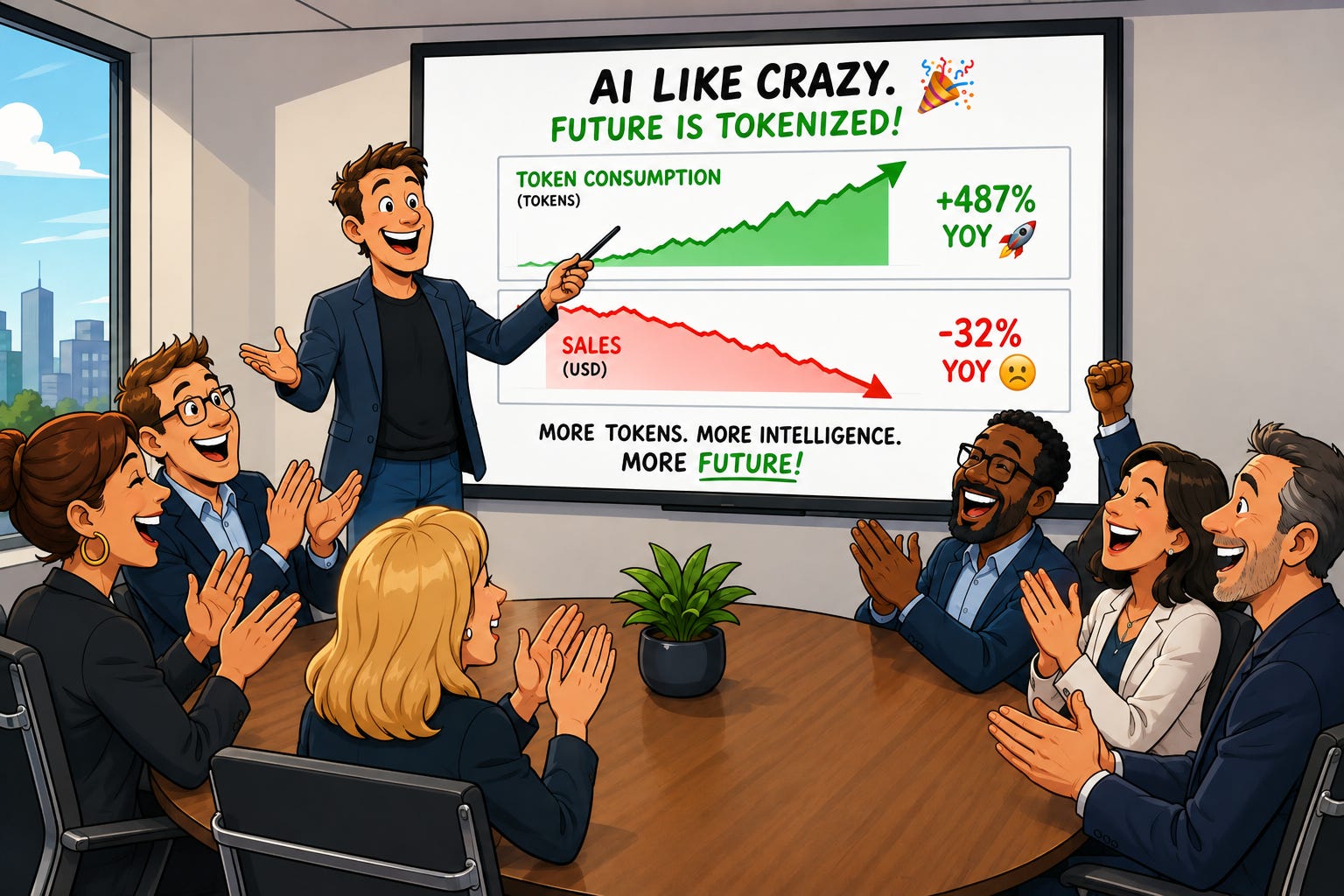
And we end up with a team managing apps created with vibe coding that break every week, unnecessary automations, emails with excess text written by a PhD in literature, and a bunch of experts creating memes that brighten our day in Slack.
Problem #2: solving one constraint creates another
Tools, including AI, by solving one constraint, create another.
A great marketing campaign, by solving the leads problem, creates a problem of operations, of inventory, of cash flow, and of unhappy customers. Hiring an excellent salesperson solves the capacity problem to attend to leads, but generates an increase in requests to marketing that the company does not have the capacity to deliver. Implementing an ERP solves the problem of centralizing data, but generates the need for new SOPs and new levels of documentation.

Technology does not correct misalignment. It amplifies it. Automating a defective process only helps you do the wrong thing faster. — Forbes | MIT, 2025.
Today, the corporate narrative is full of the supposed miracles that AI will bring to companies. However, few are talking about how, from the operator’s chair, AI is unexpectedly creating other organizational bottlenecks.
95% of corporate AI initiatives deliver zero measurable return. — MIT Media Lab, The State of AI in Business 2025.
94% of mid-market executives report using AI; only 2% have operationalized it at scale. — RSM Middle Market AI Survey.
Because AI creates new constraints while solving old ones, we must focus even more on the critical ones.
To maximize the use of AI at scale and successfully execute the implementation in the business, we must view it from the following 4 levels:
Level 1 – Clarity on the Critical Constraint
The Theory of Constraints (TOC) by Eliyahu M. Goldratt, establishes that a system (in this case, your business) will improve (grow) up to the level of your critical constraint. From there, it will not grow anymore. Everything else you do to improve it will bring internal improvements that will hardly be reflected significantly in the revenue or profit of the business.
The Critical Constraint of the business (or, alternatively, of your department) is the biggest limitation of your business and, by solving it, will generate the highest return on investment and the most progress.
Why has AI been revolutionary for software companies? Because software development is the critical constraint.
There is no software company that does not have an endless list of features and improvements that both its clients and the sales department have asked of the development department. And development, for decades, was the biggest constraint for a software company.
So, from a macro point of view, where is the critical constraint in your company?
Sales or operations? Is the critical constraint that we need to sell more, or that we don’t have the capacity to deliver more if our sales were to double?
Within sales, is our critical constraint that we don’t have enough leads, or that we are not converting at a healthy conversion rate?
If the answer is that we don’t have enough leads, is our critical constraint our prospecting frequency, or that we are not reaching our ideal client, or that the language we are using is not attractive, etc.?
This is how we define the root cause: the business's critical constraint. And the next question could be:
Which tools, including AI as one of the most powerful, could help me solve the critical constraint of my business?
Level 2 – Structure: From Boxes to Workflows
Your organizational chart was designed for people. AI lives in workflows. The implementation problem is not technical; it is structural.
When someone on your team faces a capacity limit, it is very likely that they think of a box: “I need a person, a marketing coordinator, a project manager”. We are programmed to think in boxes. Organizational charts are an inheritance of the industrial era: people in boxes, connected vertically.
Thinking in boxes in the AI era is limiting, it strengthens silos and transfers constraints across the organization. We need to move from “boxes with names” to “name + workflows”.
For example, Sofia, in the position of Customer Service Manager, is not just a box. Her role groups 6 or 7 workflows: ticket management, categorizing complaints, escalating technical problems, measuring customer satisfaction and reporting metrics to the leadership team.
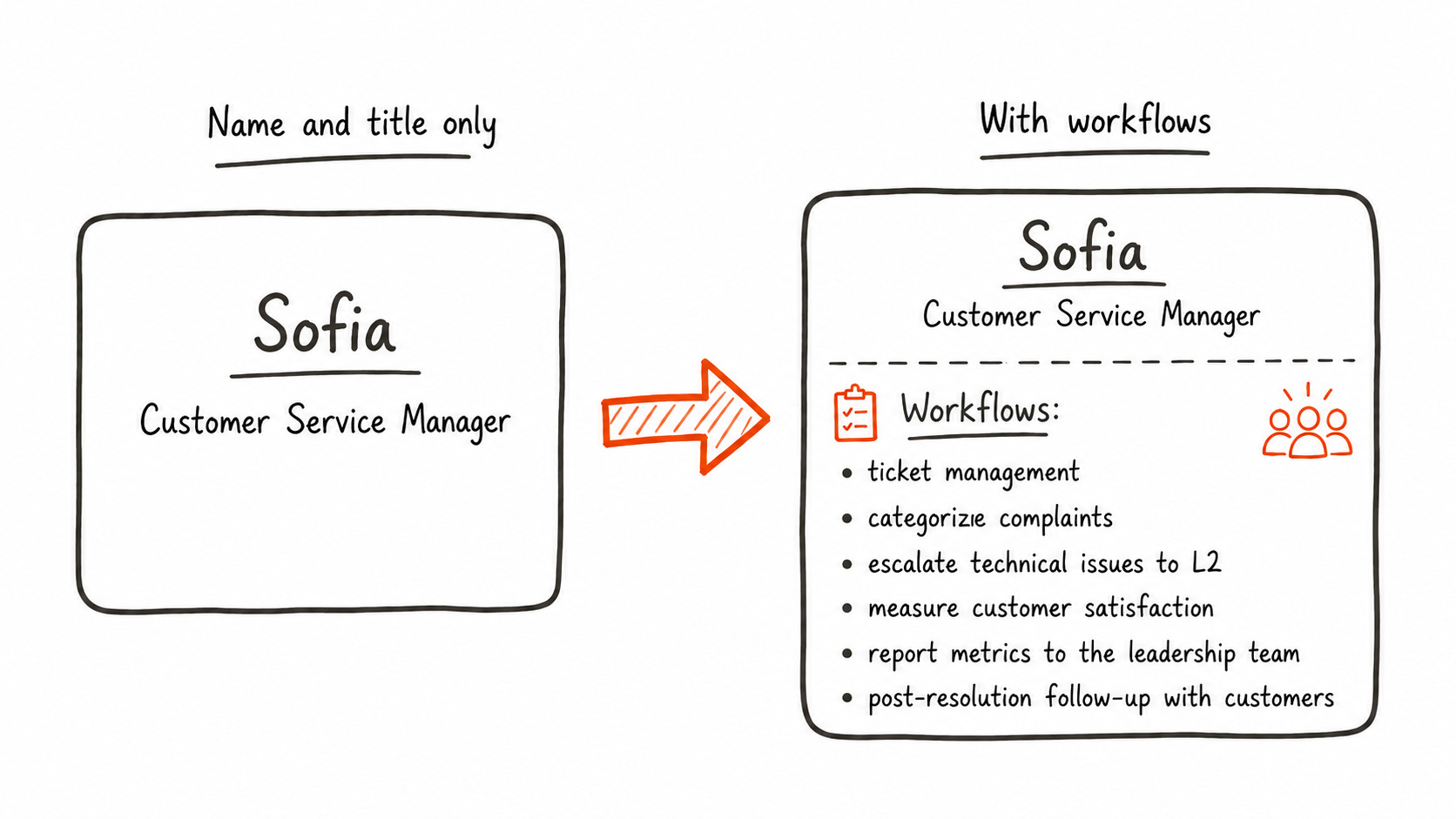
When we change the lens towards workflows, several things happen:
Automation visibility: We clearly understand what specific part of the workflow can be taken over by AI. We stop giving licenses blindly hoping “that they will be more efficient” and we prioritize tokens and effort on the tasks with the highest ROI.
Silo destruction: We see the cross-functional connections (inter-boxes) to solve constraints instead of just transferring them.
Capacity expansion: We intentionally create capacity in roles so that human talent moves to strategy or, alternatively, radically increases the throughput of their function.
The next time a leader asks you for additional headcount, do not discuss the box. Ask them to break down the workflows in which they need execution capacity.
Level 3 – Operation: SOPs and the Corporate “Brain”
The constraint to maximize AI is not Artificial Intelligence itself, but Human Intelligence. Specifically, that it is trapped in heads, not in documented systems.
Just as the largest corporations in the world often sustain themselves on an Excel macro, middle-market companies sustain themselves in the heads of Liz and Jose. Liz has been managing accounting for a decade and knows all the exceptions; Jose started in the warehouse and knows exactly how much ghost inventory there is.
When your business depends on specific people to function, you have a vulnerable operation, sustained by memory, habit and goodwill. Atlassian estimates that only 4% of companies have documented SOPs. That is, 96% are not structurally ready for AI.
To maximize this technology, the company needs to build its “Brain”.
An organization that has rigorously documented its Strategic Map (BHAG, 3-year vision, Annual Plan and quarterly goals with their defined critical constraints), its ICPs, its brand positioning and its critical SOPs, has an asymmetric advantage: it can align all the efforts of its AI agents in the same direction.
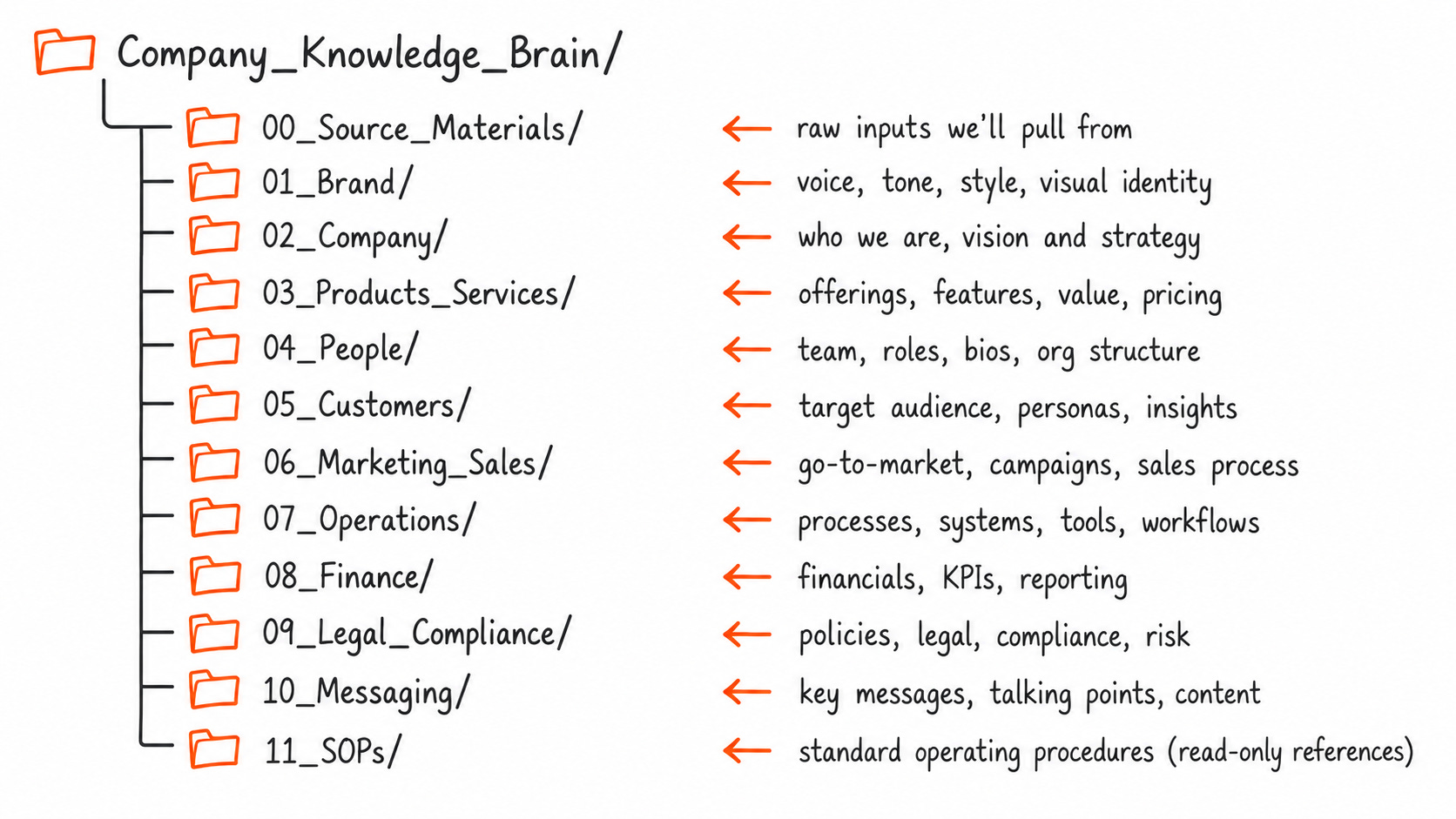
An AI agent guided by this corporate “Brain” stops being a transactional bot and becomes a partner that understands the context, the restrictions, and the strategic priorities of the business.
Level 4 – Individual: The Augmented Executive
The skill that historically defined the high-level leader is now needed even by the junior analyst: the capacity to orchestrate.
As we grow professionally, our value in the organization stops coming from our capacity to execute directly and starts to depend on our capacity to lead, manage and hold others accountable. Those who stagnate in the limiting belief of “no one is going to do it as well as I do, I prefer to do it myself”, are exactly the profiles that AI is going to displace.
We are no longer individual entities. We are the sum of our human talent plus the structure of autonomous agents that we build around us. To operate at this level, you need to learn to delegate and lead agents with the same discipline with which you lead humans.
In my case, I have restructured my directive workflow with a “board” of agents connected to my 3-year vision and to the annual objectives. For example, I have an integrating agent that organizes and delegates tasks to other models; a deep research agent that processes information before my meetings; and an analytical agent that reviews the transcripts of my strategic sessions with clients to give me feedback on my facilitation biases.
And my main agent, Arturo, has engraved in his memory that for every project, task and quarterly priority we must answer the following three questions:
Does this work significantly affect the critical constraint of my business?
Does this effort help my business sell more? or
Does this effort help my business generate more profit?
The only case to use AI in a non-critical constraint
Learning.
Intentional learning is the only case to invest time and resources in AI. But that learning must have an accelerated path to implementation in critical activities. This way we will avoid the whole organization burning tokens on PhD emails and Slack memes. And it should be viewed as an investment in the same way you invest in an advanced PowerBi or SAP course.
Why is it vital that your team start this process today? Because the throughput gap per function will increase exponentially.
Imagine Andrea, your customer service representative. She works without AI, answers the phone, is kind, and solves problems. She delivers expectations. At the competition is Johanna. Johanna does the same thing, but she has orchestrated agents around her: one schedules proactive calls to key accounts, another monitors news about her clients to trigger congratulatory emails for new branches, and another silently updates the CRM with personal notes extracted from the calls.
In 24 months, the performance gap between Andrea and Johanna will not be linear; it will be exponential. Now scale that gap into the constraints of Sales, Finance, Operations, and Human Resources.
The starting point: at the top.
Every change needs to start from the top.
“A leader who has never delegated a task to an autonomous agent cannot credibly lead an organization through this transformation. A leader who has; who understands by experience what works, what breaks and where the governance gaps are, brings something that no framework or consultant can substitute: conviction earned through action.” — Dirk Hofmann, Harvard Data Science Initiative, The OpenClaw Moment.
The AI transformation is not delegated. It is lived. The CEO who abdicates this responsibility is giving up the most important strategic decision of the decade.
Execution: Repairing the airplane mid-flight
Implementing this requires a simultaneous Top-to-Bottom and Bottom-to-Top approach, because we cannot stop the operation for 3 months to redesign the company.
In my years at Procter & Gamble as Demand Planner for the Andean region, building the forecast required reconciling two realities. The Top-to-Bottom came from the corporate goals of management. The Bottom-to-Top came from the reality of the street, adding the forecast sku by sku from the trenches.
In AI, the dynamic is identical:
Top-to-Bottom: The leadership team defines the strategic critical constraints where AI will have the biggest impact on the P&L. From there, the big projects are defined.
Bottom-to-Top: Each manager, supervisor or operator identifies 1 to 3 critical workflows in their day-to-day that, if augmented, would release a massive ROI in resources.
The way I help collaborators in the bottom-to-top exercise is with the following question: If you were not an employee of this company, but instead I had outsourced your services by hiring you as a contractor, and, in your company, YOU Inc, I was your biggest client, what would be your critical constraint to give me a service that would exceed my expectations?
Putting collaborators into a “business owner” perspective helps them tremendously to define their internal clients, and implement the concept of critical constraint in their function.
Crossing these two visions will reveal where there is alignment to accelerate, and where there are hidden productivity niches for management.
The Operating Plan (Next 4 weeks):
Define your Critical Constraints: Define them and announce them. Explain to the organization why focusing on these 1 to 3 aspects gives us the most leverage in the company.
Map the Workflows: Take your current organizational chart and demand that each “box” lists its main workflows. Choose the ones that touch the critical constraint to intervene.
Build Conviction: The entire C-Suite (starting with the CEO) must develop at least one agent to automate or augment a workflow of their own. The immediate objective is not the P&L, it is to learn, to earn operational authority through experience.
Audit Curiosity: In quarterly performance reviews, add a new metric to the KPI discussion: What workflows did you optimize with AI this quarter and how has that elevated the strategic throughput of your role? How does this effort connect to freeing our critical constraint? How does it help improve the company’s sales or margin?
We do not have great certainty of what exact capabilities AI will have in 36 months, but we do know something irrefutable: in 3 years, the difference between competitors will not be explained by who adopted AI (giving each employee 50 interns), but by who used AI in the right places and managed to amplify operational discipline, versus who used it to amplify chaos.